
EOT Crane Reference Docs
The following are a collection of reference articles that I have collected over the years.

The Holy Trinity of EOT Crane Runway Installation Tolerances
I have three “go to” specifications that I use every time I’m working on an Overhead Crane runway alignment issue. This “holy trinity” of critical runway docs are;
CMAA Spec 70 for Overhead and Traveling Cranes, Table 1.4.2-1 Crane Runway RAIL Tolerances. This determines alignment requirement for the crane rail (as opposed to the runway beam).
MBMA Metal Building Systems Manual, Table 6.1: Crane Runway BEAMS Erection. The document, although it looks identical to the CMAA 70 table, determines the requirements for the runway support (wide-flange) beams (as opposed to the runway rail).
AISC Steel Design Guide 7, Section 19. Crane Runway Fabrication and Erection Tolerances. This spec dictates the alignment requirements between the runway (wide-flange) beams and the runway rail.
It should be noted that as a result of this standard, the center line of the runway rail’s maximum deviation from the center line of the runway beam is no greater than +/- 3/4 of the width of the runway beam’s web thickness. This therefore eliminates the technique of using the thread length of a J-Bolt/Hook-Bolt to make a straight rail on top of a shoddy runway beam installation.
For downloadable copies of the relevant pages in each of the specs click the button below. Note these are only those pages relevant to overhead crane runway alignment.

An Annotated guide to OSHA 1910.179 Overhead Cranes and Gantrys.
The following is a reprint of the Federal Spec OSHA 1910.179 to which I’ve annotated with my own comments and review.

Blue- State OSHA White- Federal OSHA plans
A Guide to the state OSHA plans (and there’s a lot of them)!
It's not like the Byzantine nature of the OSHA spec with "Incorporation by Reference" is not confusing enough, the writers of OSHA allowed the states to administer their own programs and write their own plans. The only requirement was that the state plans had to be equal or greater (more stringent) than the federal program. As a result, we have almost half of the states with their own programs. These programs are anywhere from a simple adoption of the federal plan to a totally rewritten plan. Attached is a list of the states, the extent of difference from the federal program and contact information.
You think you just had OSHA to worry about???
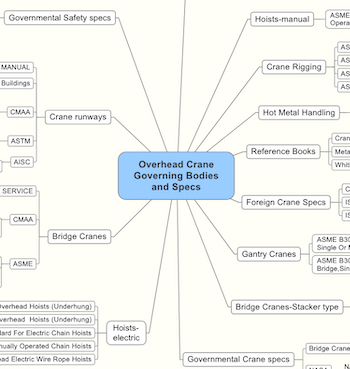
The following is a mindmap of the all the laws, specs and consensus standards that make up the US Electric Overhead Traveling Bridge Crane Safety requirements.

OSHA 1910.79: Overhead Crane Document Family Tree.
OSHA 1910.179 is less than 7000 words, but that's just the tip of the Overhead Crane regulatory iceberg. This document is an examination into the broad family of documents that makes up the US electric overhead traveling crane regulatory world.

OSHA 1910.6 Incorporation By Reference.
OSHA is much more than just the couple thousand pages of the 1910, 1915 and 1926 codes. In section 1910.6 OSHA "Incorporates by Reference" over two hundred other documents. The following is a listing of the complete OSHA 1910.6 with all 197 references and my annotations.
Comprehensive Guide to OSHA Mandated Overhead Crane Inspections
Recently I was an Expert Witness on an accident involving an overhead bridge crane, and the lawyer asked me to define the OSHA requirements for crane inspections. The more I explained, the more confusion I saw on the lawyer's face.
Much of the problem lies in the fact that OSHA 1910.179 is not the only reference required for this information. Because of OSHA 1910.6, Incorporation by Reference, it is necessary that you also include the inspection information contained in ASME/ANSI B30.2 Overhead and Gantry Cranes and CMAA Spec 70 for Overhead and Traveling Cranes. Further, all three organizations issue periodic "clarifications" and "Letters of Interpretation," which also come into play.
To provide a simple guide, I've put together a mind map distilling all the above reference material into a single page.

Here’s a downloadable PDF version.
OSHA Crane Inspection Requirements
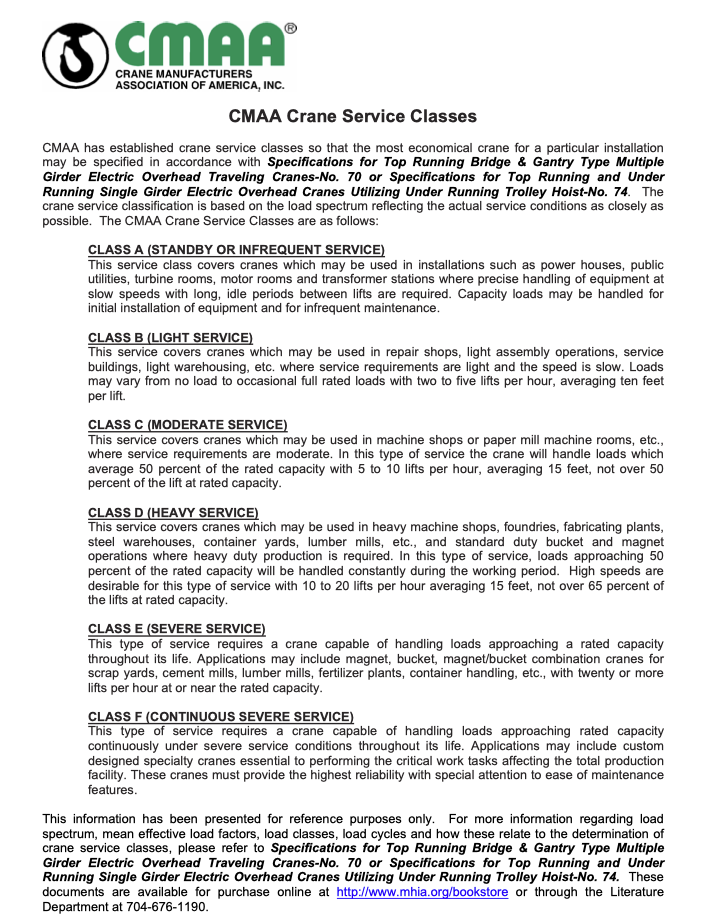
CMAA Spec 70 Duty Cycle Service Classifications
B30.2 Annotated Operator Training Resource

Hands-on Operator Training
It’s important to understand that OSHA 1910.179 does not specify detailed operator training requirements — it mandates who may operate a crane, leaving the “how to train” details to referenced industry standards such as ASME B30.2.
What 1910.179 Actually Says About Operators
The standard’s core operator requirement appears in §1910.179(b)(8): ”Only designated personnel shall be permitted to operate a crane covered by this section.” That single sentence is the only explicit operator training language in the regulation.
The term ”designated” is defined in §1910.179(a)(35) as “selected or assigned by the employer or the employer’s representative as being qualified to perform specific duties.” Because “qualified” is undefined in the standard, OSHA has stated in official interpretations that it looks to industry standards — primarily ASME B30.2 — to fill that gap.
No Certification Requirement for General Industry
Unlike the construction standard (29 CFR 1926.1427, which requires third-party certification), general industry overhead crane operators are not required to hold formal certification. The employer simply designates who is qualified. This critical distinction often surprises compliance professionals.
Where the Training Detail Actually Lives: ASME B30.2
Because OSHA defers to B30.2 on what “qualified” means, that standard effectively sets the training floor. Key B30.2 requirements include:
- Training must be equipment-specific — covering the exact crane type, controls (cab, pendant, or radio), environment, and load types.
- Training must be completed before unsupervised operation, even for experienced operators
- Both the classroom (knowledge) and hands-on (skills) components are required
- Retraining is required after: an observed unsafe operation, an accident or near-miss, an assignment to a different crane type, or significant workplace changes
- Annual refresher training is a recognized best practice within B30.2 programs
Practical Training Topics Required
While 1910.179 doesn't list topics, OSHA's interpretations and B30.2 together drive training to include:
- Pre-operational and periodic inspections
- Load capacity and rated load identification
- Safe load handling, rigging, and sling use
- Hand signals and communication (OSHA/ANSI standard signals)
- Swing radius hazards and prohibited actions (swinging loads over workers)
- Lockout/Tagout procedures
- Emergency stop and shutdown procedures
- Recognition of equipment defects requiring removal from service
Employer Liability Framing
The employer bears full responsibility for designating qualified operators and ensuring adequate training. Because 1910.179 is a performance-based standard on this point, OSHA can cite an employer under the General Duty Clause (Section 5(a)(1)) or under 1910.179(b)(8) if an unqualified operator causes an incident — even without a checklist-specific violation. This makes a documented, B30.2-compliant training program essential for defensibility in any incident investigation or litigation.
Click the link below to see a copy of B30.2 Chapter 2-3 Operator Training with full annotations and cheatsheet notes.